GLP-1 medications like Ozempic and Wegovy have changed the weight loss conversation in a real way. Millions of people are hitting body goals they have worked toward for years. But there is a side effect that does not always make it into the conversation before someone starts treatment: Ozempic face.
It is not a medical diagnosis. It is not caused by the medication itself. But it is something a growing number of people notice after significant weight loss on semaglutide — and once you know what to look for, you cannot unsee it. Gaunt cheeks. A hollowed look around the eyes. Skin that seems to have aged faster than the number on the scale dropped.
The good news is that Ozempic face is both preventable and treatable. This article covers exactly what it is, why it happens, what it looks like, and what you can do about it — whether you are already on a GLP-1 medication or just beginning to research your options.
What Is Ozempic Face?
Ozempic face refers to the visible facial changes that can occur as a result of rapid weight loss, particularly in people taking GLP-1 receptor agonists like semaglutide (Ozempic, Wegovy) or tirzepatide (Mounjaro, Zepbound).
The term was coined by a New York dermatologist who began noticing a pattern among patients on these medications: faces that looked older, hollower, and more aged than expected given their overall health improvement. It spread quickly on social media and has since become one of the most searched aesthetic concerns associated with GLP-1 use.
What is important to understand is that Ozempic face is not a pharmacological side effect. The medication itself does not directly cause facial aging. The culprit is rapid fat loss — specifically, the loss of subcutaneous fat in the face and neck that happens when the body sheds weight quickly.
The same changes can occur after bariatric surgery or any other approach that produces fast, significant weight loss. GLP-1 medications are simply producing these results in a much larger population, and doing so faster than traditional diet and exercise typically would.
Why Rapid Weight Loss Ages Your Face
To understand why this happens, it helps to understand what fat actually does for the face.
Subcutaneous fat — the fat that sits just beneath the skin — is not just padding. It is structural. It gives the face its roundness, softness, and youthful contour. As we age, we naturally lose this fat gradually over decades, which is one of the primary reasons faces look older over time. Rapid weight loss compresses that timeline.
When the body loses weight quickly, it pulls from fat stores throughout the body — including the face. The result is facial hollowing and volume loss that can appear almost overnight relative to how long natural aging takes. Skin that once had underlying support suddenly has less structure beneath it.
The speed of weight loss matters more than most people realize. Losing one to two pounds per week gives skin time to adapt. Losing significantly faster than that — which GLP-1 medications can facilitate, especially at higher doses — gives skin very little time to adjust. Two key proteins drive this:
Collagen provides the structural scaffolding of the skin. Rapid weight loss depletes it faster than the body can replenish it, leading to wrinkles and a loss of firmness.
Elastin is what allows skin to bounce back. When elastin is compromised, skin does not retract the way it should after volume is lost — leading to sagging and laxity.
In South Florida, where sun exposure is year-round and UV damage already accelerates collagen breakdown, people on GLP-1 medications can find that the combination of medication-driven fat loss and existing sun-related skin changes produces more pronounced results than they anticipated.
What Does Ozempic Face Look Like?
The changes are recognizable once you know what to look for. They tend to cluster around specific areas of the face where subcutaneous fat plays the biggest structural role.
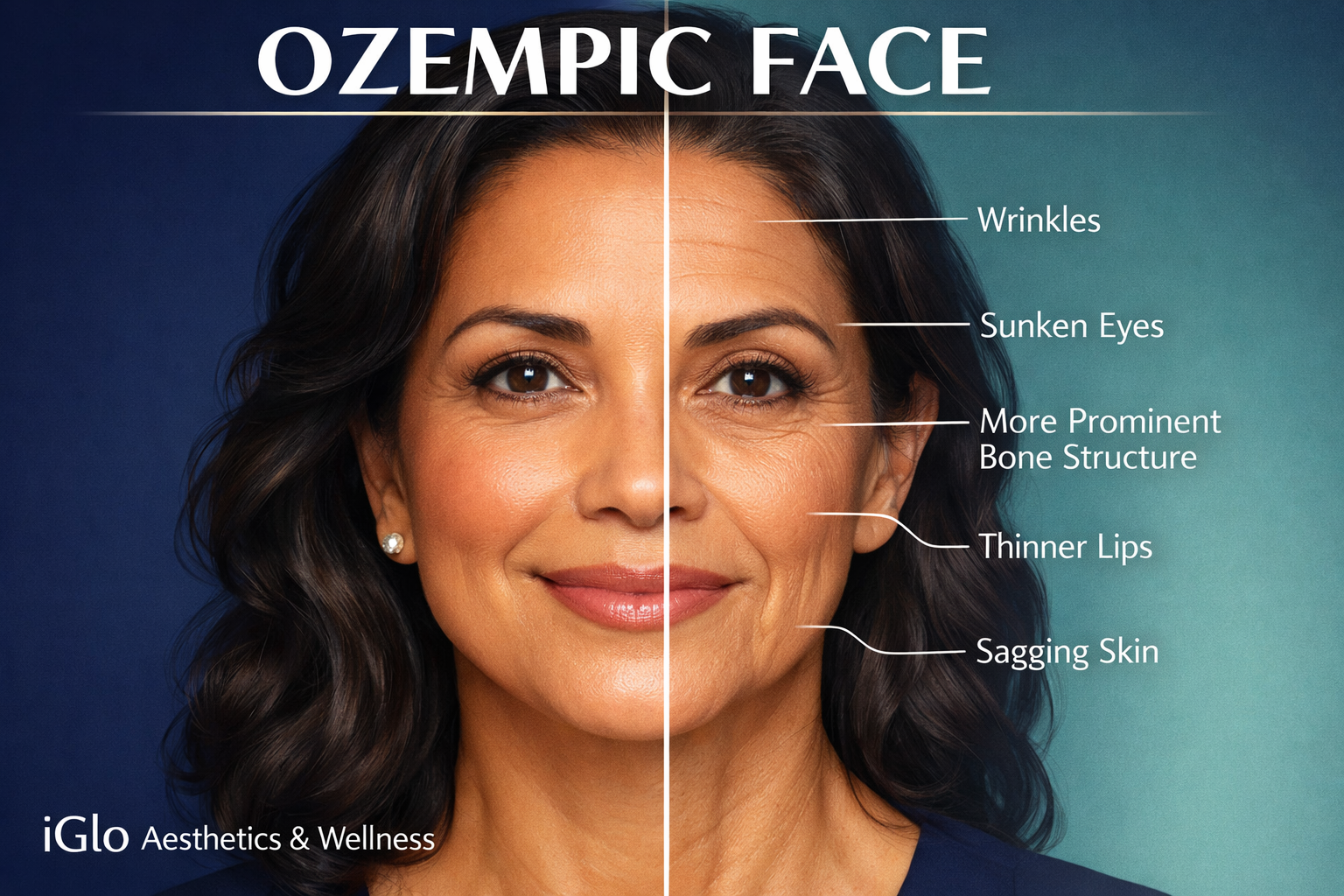
Sunken or hollowed cheeks are typically the most noticeable sign. The midface loses volume and the cheekbone area can take on a gaunt, skeletal quality that reads as unwell rather than slim.
Jowling and sagging skin along the jawline occur when the skin that previously had fat beneath it loses its support structure. The skin descends rather than retracting, creating the appearance of loose, hanging skin at the jaw and neck.
Sunken or deep-set eyes result from fat loss around the orbital area. The eyes can appear to sit deeper in the face, making dark circles more prominent and giving the face a tired, aged quality. Learn more about under-eye concerns and how they are treated.
Thinning lips happen because fat contributes to lip volume. As overall facial fat decreases, lips can appear thinner and less defined.
New or deepened wrinkles appear as collagen production slows and skin loses the volume that previously kept it smooth. Nasolabial folds — the lines from the nose to the corners of the mouth — often deepen noticeably.
More prominent bone structure can also emerge. While this sounds appealing, when the overlying tissue has lost too much volume, prominent cheekbones and jawlines can look harsh rather than defined.
Most people on GLP-1 medications notice these changes within three to six months of significant weight loss, though the timeline varies depending on the speed of loss, age, starting skin quality, and genetic factors.
How to Prevent Ozempic Face While on GLP-1 Medication
Prevention starts before the weight comes off. If you are at the beginning of your GLP-1 journey, these steps give you the best chance of protecting your face through the process.
Pace your weight loss deliberately. The single most effective prevention strategy is slowing the rate of loss. Targeting one to two pounds per week rather than maximizing your dose for the fastest possible results gives your skin time to adapt and your body time to maintain facial volume more naturally. Working with a clinical provider who manages your GLP-1 dosing with aesthetics in mind makes this significantly easier.
Prioritize protein intake. Adequate protein does two things: it preserves lean muscle mass during caloric restriction and it supports collagen production in the skin. Most adults losing weight on GLP-1 medications should be consuming at minimum 0.7 to 1 gram of protein per pound of body weight daily. This is an area where many patients fall short, particularly as appetite suppression from the medication reduces overall intake.
Stay hydrated. Skin elasticity is directly tied to hydration. Well-hydrated skin maintains more of its bounce and resilience during weight changes. In the South Florida heat, hydration needs are higher than average — and they are even more relevant for patients on semaglutide, which can reduce the natural thirst response in some users.
Use sunscreen every single day. UV exposure breaks down collagen and elastin independently of weight loss. In Miami, the baseline UV index is among the highest in the continental United States for much of the year. Layering GLP-1-related collagen depletion on top of ongoing UV damage accelerates skin aging significantly. A broad-spectrum SPF 30 or higher, worn daily, is non-negotiable.
Support your skin with a targeted skincare routine. Retinoids support collagen synthesis and can slow the visible signs of skin aging. Peptide-based moisturizers help reinforce the skin barrier. Starting or strengthening a skincare routine before and during GLP-1 treatment is a practical step that requires no procedures and zero downtime.
Consider early aesthetic intervention. Many patients wait until facial changes are advanced before addressing them. Earlier intervention — even a single biostimulator treatment during the weight loss phase — can prime the skin to maintain collagen production as volume is lost, reducing how pronounced the changes ultimately become.
How to Treat Ozempic Face: Aesthetic Solutions That Work
If you are already noticing facial changes from weight loss, the right treatments can restore volume, improve skin quality, and re-establish the contours that rapid fat loss has altered. The approach depends on what you are seeing and how pronounced the changes are.
Dermal Fillers
Hyaluronic acid dermal fillers like Juvederm and Restylane are the most immediate solution for restoring lost facial volume. They work by physically replacing the subcutaneous volume that weight loss removed, lifting sunken areas, softening deep lines, and restoring contour to the cheeks, under-eyes, and lips.
Results are visible immediately and typically last 12 to 18 months depending on the product used and the area treated. For patients who are still actively losing weight, timing matters — treating too early can require more product as weight continues to shift. A skilled injector will assess your trajectory and recommend the right time to begin.
Biostimulators (Sculptra and Radiesse)
Biostimulators take a different approach than traditional fillers. Rather than simply replacing volume, they work by stimulating your body's own collagen production over time. This makes them particularly well-suited for Ozempic face, where the underlying issue is not just lost volume but also depleted collagen and reduced skin quality.
Sculptra (poly-L-lactic acid) is injected in a series of sessions and gradually builds collagen over three to six months. The results develop slowly and look exceptionally natural — which is one reason it has become a preferred treatment for patients experiencing the gradual facial changes associated with GLP-1 use. Results can last up to two years.
Radiesse(calcium hydroxylapatite) provides both immediate volumizing and biostimulatory effects. It adds structure while also triggering collagen production, making it a strong option for areas like the cheeks and jawline where both volume and lift are needed.
For many patients experiencing Ozempic face, a combination of a biostimulator and a hyaluronic acid filler delivers the most comprehensive result — one product rebuilding the foundation, the other addressing specific surface concerns.
RF Microneedling
Radiofrequency microneedling addresses the skin laxity and texture changes that volume loss leaves behind. The treatment delivers controlled radiofrequency energy deep into the dermis through tiny needles, triggering a wound-healing response that produces new collagen and elastin.
For patients with sagging skin along the jawline, neck laxity, or overall loss of skin firmness, RF microneedling produces measurable tightening over a series of three treatments spaced four to six weeks apart. Results continue to improve for several months after the final session as collagen remodeling progresses.
RF microneedling works particularly well in combination with biostimulators. The microneedling improves surface texture and tightness while the biostimulator rebuilds deeper structural volume — a two-pronged approach that addresses Ozempic face from both directions.
Why Managing Your GLP-1 Medication and Your Aesthetics Together Matters
Most people on GLP-1 medications are managing their medication through one provider and their skin concerns through another — or not addressing the aesthetic side effects at all. This separation often leads to suboptimal outcomes on both fronts.
At iGlo Aesthetics and Wellness in Miami Lakes, GLP-1 medication management and aesthetic treatment happen under the same roof. That matters for a straightforward reason: the decisions made about your dosing, the pace of your weight loss, and the timing of your aesthetic treatments are all connected. When one provider is thinking about all of them together, the results — both in terms of body composition and facial appearance — are more predictable and more satisfying.
Patients who are on iGlo's GLP-1 program have the advantage of working with a clinical team that is actively thinking about the full picture: not just the number on the scale, but how the body is responding visually and how to protect the face through the process. For those who come in after weight loss having already noticed facial changes, iGlo's aesthetic providers can build a treatment plan that addresses what is actually happening — the specific combination of volume loss, skin laxity, and collagen depletion — rather than a one-size approach.
South Florida patients have an aesthetic standard that matches the lifestyle here. Feeling confident at the pool, at work, and out in Miami does not stop being important just because you are also working on your health. The goal is to look as good as you feel — and with the right clinical support, that is entirely achievable.
"One of the most common things I hear from patients after significant weight loss is that they feel better than they have in years, but they do not recognize their face. That disconnect is real, and it deserves a real clinical response — not a generic skincare tip. At iGlo, we think about GLP-1 treatment and aesthetic outcomes together from the very beginning, because how you look and how you feel should both be part of the goal."Katrina Friedberg, MSN, APRN, FNP-BC · iGlo Aesthetics & Wellness, Miami Lakes
Frequently Asked Questions About Ozempic Face
Is Ozempic face permanent?
Ozempic face does not resolve on its own over time. If you maintain your weight loss, the facial changes associated with it will remain without intervention. Regaining weight can restore some facial volume, but that is not a clinically recommended approach. The more practical path is aesthetic treatment — dermal fillers, biostimulators, or RF microneedling — which can effectively restore the appearance without reversing your health progress.
Does Ozempic face happen to everyone on semaglutide?
Not everyone experiences pronounced facial changes, but the risk increases with the speed of weight loss, the amount of weight lost, and age. Older patients have lower baseline subcutaneous fat reserves, which means less cushion to lose before changes become visible. Patients who lose weight gradually — one to two pounds per week — are meaningfully less likely to experience significant facial changes than those who maximize their dose for the fastest results.
What is the best treatment for Ozempic face?
The best treatment depends on which changes are most prominent. For volume loss, dermal fillers like Juvederm or Restylane provide immediate results. For collagen depletion and longer-term facial quality, biostimulators like Sculptra or Radiesse are highly effective. For skin laxity and sagging, RF microneedling produces measurable tightening. Many patients benefit most from a combination approach tailored to their specific presentation.
Can you prevent Ozempic face while still losing weight?
Yes. The most effective prevention strategy is pacing weight loss at one to two pounds per week rather than maximizing medication dose. Supporting that with adequate protein intake, consistent hydration, daily sun protection, and a collagen-supporting skincare routine all reduce the risk of pronounced changes. Early aesthetic intervention — such as a biostimulator treatment during the weight loss phase — can also help the skin maintain collagen production as volume decreases. At iGlo, Katrina Friedberg, MSN, APRN, FNP-BC works with GLP-1 patients to build a treatment plan that considers both weight loss pace and facial preservation from the start.
How soon after weight loss can you get fillers or skin tightening?
Timing depends on whether your weight is stable. Treating with fillers while weight is still actively shifting can mean the results change as the face continues to lose volume. As a general guideline, waiting until weight has been stable for at least one to three months before volumizing treatments produces more lasting and predictable outcomes. RF microneedling and biostimulators can often begin during the weight loss phase, as they work on skin quality rather than simply adding volume.
Does iGlo treat Ozempic face in Miami Lakes?
Yes. iGlo Aesthetics and Wellness, located in Miami Lakes, Florida, offers a full suite of treatments for patients experiencing facial changes from GLP-1-related weight loss — including dermal fillers, Sculptra and Radiesse biostimulators, and RF microneedling. iGlo also prescribes and manages GLP-1 medications in-house, making it one of the few practices in the Miami area where patients can address both their weight loss journey and its aesthetic effects in one place.
iGlo Aesthetics & Wellness · Miami Lakes, FL
The Weight Loss Win You Worked For Should Show on Your Face
You put in the work. The number on the scale moved. Your health improved. The last thing you should accept is a face that does not reflect any of that progress. Schedule a consultation with Katrina Friedberg, MSN, APRN, FNP-BC and find out what a personalized treatment plan looks like for you.
Book Your ConsultationOzempic face is common, it is understandable, and it is treatable. At iGlo Aesthetics and Wellness in Miami Lakes, the clinical team brings together GLP-1 management and aesthetic medicine so your results are complete — from the inside out. You deserve to feel as good as you look.