


What Does Semaglutide Cost in Miami Lakes? Is a Supervised Program Worth It?
TL;DR
- Semaglutide in Miami Lakes typically costs between $250 and $450 per month depending on dosage and program structure.
- At iGlo Aesthetics & Wellness, that monthly cost includes clinical oversight by a board-certified nurse practitioner, personalized dosing adjustments, and ongoing support. Not just the medication.
- Programs that bundle supervision with the medication cost more than sourcing the drug alone, and that difference has a direct impact on safety and results.

There is a version of semaglutide that costs less than $200 a month. There is also a version that costs $1,200. Neither number tells you much without knowing what is actually included, and in South Florida, where weight loss clinics and telehealth programs have multiplied faster than most people can track, that distinction matters more than ever.
For women in Miami Lakes who are tired of doing everything right and still not seeing the scale move, semaglutide is a real clinical tool backed by strong trial data. The medication alone, though, is not the whole program. Clinical oversight, dosing precision, and metabolic context are where supervised programs at practices like iGlo Aesthetics & Wellness separate themselves from the mail-order alternatives.
This article breaks down exactly what semaglutide costs in Miami Lakes, what that cost covers, who qualifies, and what results you can realistically expect from a properly supervised program.
What Does Semaglutide Actually Cost in Miami Lakes?
Monthly costs for supervised semaglutide programs in Miami Lakes range from $250 to $450. That range reflects differences in dosage tier, program structure, and the level of clinical involvement included.
Programs at the lower end sometimes cover medication only, with minimal check-ins and no real dosing management. Programs at the higher end, including the supervised medical weight loss program in Miami Lakes at iGlo, include the full clinical layer: nurse practitioner oversight, labs, dosing adjustments, and ongoing monitoring.
The price you find on a telehealth comparison site and the price for a supervised in-person program are not the same product.
What Is and Is Not Included in a Semaglutide Program
A fully supervised program at iGlo Aesthetics & Wellness includes the medication, an initial consultation, baseline lab work, and ongoing dosing management by a board-certified nurse practitioner. Follow-up visits and lab interpretation are built in, not billed separately.
What some lower-cost options omit: any clinical review before prescribing, monitoring for side effects, dosing flexibility based on your body's response, and a real point of contact when something feels off. Semaglutide interacts with other medications, affects blood sugar regulation, and requires gradual dose escalation. Managing that without a clinician is where problems happen.
Compounded vs. Brand-Name Semaglutide: What You Are Actually Comparing
Ozempic and Wegovy are brand-name semaglutide products manufactured by Novo Nordisk. Compounded semaglutide contains the same active ingredient, prepared by a licensed compounding pharmacy under a valid prescription. The primary practical difference is cost. Compounded versions are significantly less expensive, which is why most medical weight loss programs, including supervised ones, use compounded formulations.
The comparison that actually matters is not brand vs. compounded. It is supervised vs. unsupervised. A compounded semaglutide program with full clinical oversight from a board-certified NP is a different product entirely from a brand-name prescription ordered through a telehealth platform with no follow-up.
How Does a Supervised Semaglutide Program Work?
A supervised program begins with an intake consultation and baseline labs before any medication is prescribed. Dosing starts low, typically 0.25 mg weekly, and increases gradually based on your individual response. A clinician monitors side effects, weight trends, and metabolic markers throughout.
The escalation schedule is not a fixed calendar. It is responsive. That is the core of what supervision means in practice.
The Onboarding Process at iGlo
The first step at iGlo Aesthetics & Wellness is a consultation with Katrina Friedberg, MSN, APRN, FNP-BC, who reviews your health history, current medications, weight history, and any hormonal or metabolic factors that might affect your response to the medication. Lab work is ordered before the first dose. Your treatment plan is built around what the labs and your history actually show, not a default protocol handed to every new patient.
This intake process takes longer than filling out a form online. That is the point.
How Dosing Adjustments Are Made
Dosing decisions at iGlo are based on three factors: how your body is tolerating the current dose, what your weight trend looks like over the previous weeks, and whether any side effects warrant pausing before moving up. Common side effects, including nausea, fatigue, and changes in digestion, are manageable when someone is monitoring them. They become problems when no one is.
Most patients reach their effective maintenance dose somewhere between 1 mg and 2.4 mg weekly. The right dose for your body is found through clinical observation, not by defaulting to the highest tolerated amount.

Who Is a Good Candidate for Semaglutide in Miami Lakes?
Ideal candidates have a BMI of 27 or higher with at least one weight-related health condition, such as elevated blood pressure, high cholesterol, or insulin resistance, or a BMI of 30 or higher without an associated condition. Patients who have struggled with diet and exercise alone, particularly those with hormonal contributors to weight gain, tend to respond well.
That last group is worth pausing on. A significant portion of women between 35 and 60 who present as "not losing weight despite doing everything right" have an underlying hormonal picture driving the plateau. Addressing that within a supervised program changes the outcome.
Who Should Not Use Semaglutide
Semaglutide is not appropriate for everyone. Patients with a personal or family history of medullary thyroid carcinoma, multiple endocrine neoplasia syndrome type 2, or a history of pancreatitis are not candidates. Pregnant women and those with certain gastrointestinal conditions are also excluded. This is precisely why a pre-prescription consultation with labs is not optional. It is the mechanism that catches contraindications before they become harm.
The Role of Hormonal Health in Weight Loss Response
Hormonal contributors to weight gain, particularly low estrogen, elevated cortisol, and thyroid dysfunction, can blunt the response to semaglutide if left unaddressed. Patients who are evaluated for these factors at the outset, and who have them managed alongside the GLP-1 protocol, consistently show better results than those treated with medication alone.
At iGlo, this is part of the intake review. It is not a conversation that happens later.
What Results Can You Realistically Expect?
Clinical trials show average weight loss of 10 to 15 percent of body weight over 68 weeks with semaglutide. In supervised programs where patients maintain lifestyle habits alongside the medication, results tend to land at the higher end of that range.
For a 185-pound woman, 15 percent is nearly 28 pounds. The trial data shows continued loss through the full treatment period, not just the first few months.
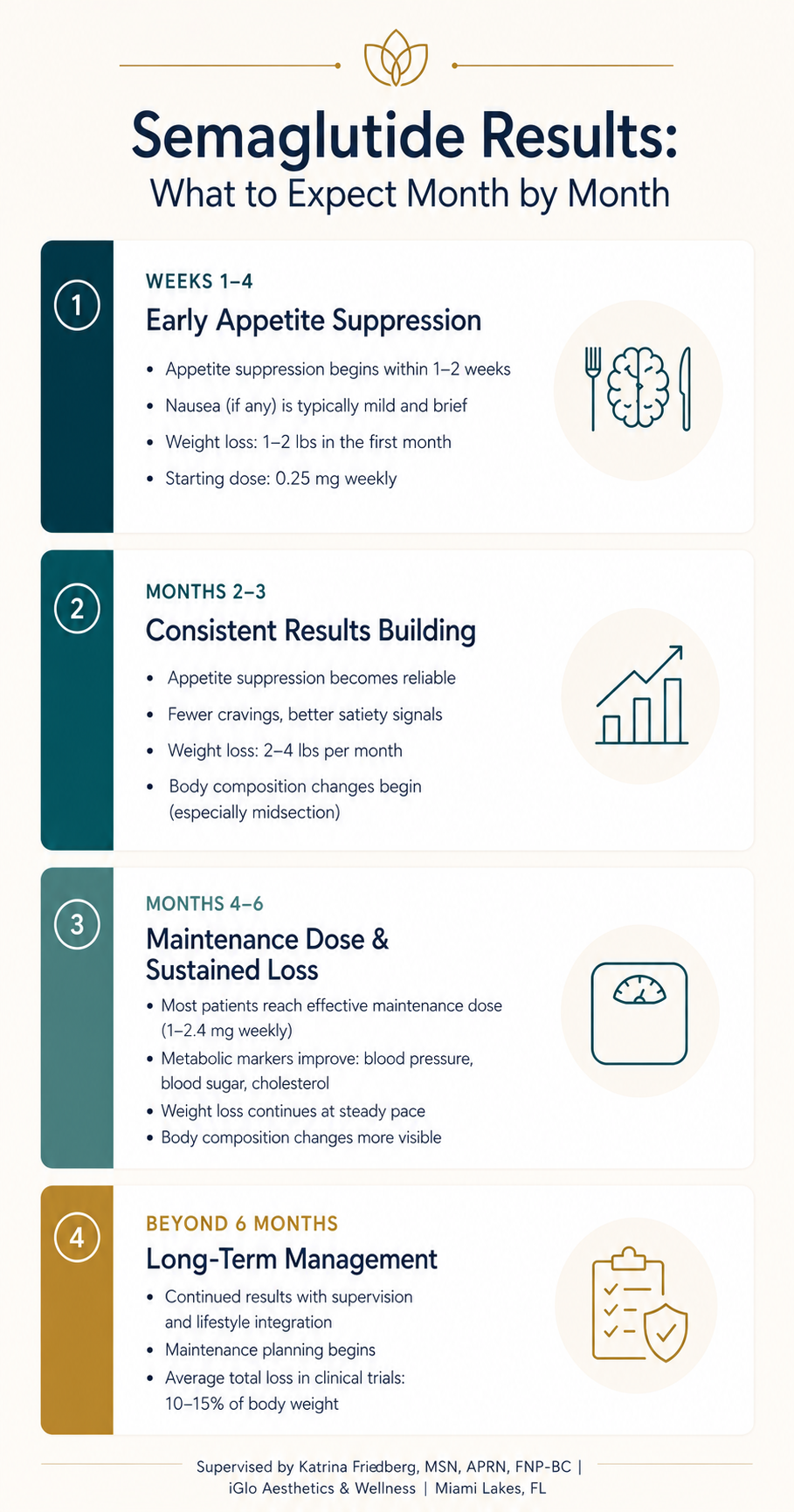
Month-by-Month Expectation Guide
Weeks 1 to 4: Appetite suppression begins within the first one to two weeks. Nausea, if it occurs, is usually mild at the starting dose and resolves as the body adjusts. Weight loss during this phase is modest, around one to two pounds.
Months 2 and 3: Appetite suppression becomes consistent. Patients report fewer cravings and less interest in eating past the point of comfortable fullness. Weight loss accelerates, with many patients losing two to four pounds per month. Body composition changes, particularly around the midsection, begin to become visible.
Months 4 through 6: Most patients are at or near their maintenance dose. Weight loss continues at a steady pace. Metabolic markers including blood sugar regulation, blood pressure, and cholesterol levels often improve alongside the scale changes.
Beyond Month 6: Results continue with consistent supervision and lifestyle integration. This is also when the conversation about long-term maintenance strategy becomes relevant.
What Happens After You Reach Your Goal Weight
Stopping semaglutide without a maintenance plan results in significant weight regain for most patients. Research puts that figure at a substantial portion of lost weight within twelve months of discontinuation. This is not a failure of the medication. It reflects the chronic nature of obesity and metabolic dysfunction.
Supervised programs at iGlo address this by building sustainable habits during the active medication phase, so patients are not solely dependent on the drug to maintain their results. Your semaglutide cost breakdown and long-term planning are discussed at the outset, not as an afterthought.
Why Clinical Supervision Matters for Semaglutide Patients in South Florida
The Miami area has seen a significant surge in online-only and telehealth-only semaglutide programs over the past two years. Without clinical oversight, dosing errors, unmanaged side effects, and undetected contraindications are demonstrably more common. In-person supervision changes the risk profile of the medication in a concrete way.
It also changes the results. Patients with a real clinician reviewing their progress make better dosing decisions, catch plateaus earlier, and have someone who can identify when a hormonal or metabolic factor is interfering with progress.
What to Ask Any Provider Before Starting
Before committing to any semaglutide program, get clear answers to these four questions.
Will labs be reviewed before I receive my first dose? If the answer is no, that tells you something. Who is my point of contact if I experience a side effect? An email address is not the same as a clinician. How are dosing decisions made, on a fixed schedule or based on my individual response? What is the plan if I stop losing weight, or once I reach my goal?
Those answers will sort a clinical program from a subscription service quickly.
How iGlo's Program Differs From Telehealth-Only Options
iGlo Aesthetics & Wellness accepts a limited number of new weight loss patients each month specifically to maintain the clinical oversight standard that makes the program effective. Katrina Friedberg reviews every patient's labs personally. Dosing decisions are made within a real clinical relationship, and patients have direct access when something comes up, not a ticketing system.
That is not a differentiating feature of the program. It is the program.
Frequently Asked Questions About Semaglutide in Miami Lakes
How much does semaglutide cost per month in Miami Lakes?
In Miami Lakes, supervised semaglutide programs typically range from $250 to $450 per month. This includes the medication, clinical oversight by a board-certified nurse practitioner, dosing adjustments, and ongoing monitoring. Medication-only sources may cost less upfront but do not include the clinical support that makes the program safe and effective over time.
Is semaglutide the same as Ozempic?
Semaglutide is the active ingredient in both Ozempic and Wegovy. Ozempic is FDA-approved for type 2 diabetes management; Wegovy is FDA-approved specifically for chronic weight management. Medical weight loss programs often use compounded semaglutide, which contains the same active ingredient and is prescribed by a licensed clinician. In Florida, nurse practitioners with prescriptive authority, such as those at iGlo Aesthetics & Wellness, can prescribe and supervise these programs legally.
How long does it take to see results from semaglutide?
Most patients notice appetite suppression within the first one to two weeks. Measurable weight loss typically becomes visible by weeks four to six. Significant body composition changes, particularly around the midsection, are usually apparent by month three, with continued improvement over six to twelve months in a supervised program.
Do I need a prescription for semaglutide in Miami Lakes?
Yes. Semaglutide is a prescription medication and must be prescribed by a licensed healthcare provider. In Florida, nurse practitioners with prescriptive authority can prescribe and supervise semaglutide programs. Online sources that bypass a clinical consultation are not operating within Florida's prescribing standards.
What happens if I stop taking semaglutide?
Research shows that most patients regain a significant portion of lost weight within twelve months of stopping semaglutide without a maintenance plan. This is why supervised programs at iGlo emphasize building sustainable habits during the active medication phase, so the results you achieve have a foundation that holds after you taper off.
Katrina Friedberg's Perspective on What Makes a Program Work
"In my experience, the patients who get the most out of a semaglutide program are the ones who come in understanding that the medication is a tool, not a solution on its own. I spend a significant amount of time in the initial consultation reviewing metabolic history, because what looks like a weight issue is often a hormonal or inflammatory issue underneath it. When we address the full picture, the results are meaningfully better. That is what clinical supervision actually means in practice."
— Katrina Friedberg, MSN, APRN, FNP-BC

Ready to Find Out If You Are a Candidate?
iGlo Aesthetics & Wellness accepts a limited number of new weight loss patients each month. That is a deliberate choice. It is how the team maintains the level of clinical attention that makes this program worth doing.
If you are in Miami Lakes, Hialeah, Doral, Pembroke Pines, or Miramar and have questions about whether semaglutide is right for you, the first step is a consultation. Katrina Friedberg, MSN, APRN, FNP-BC, with more than 10 years of clinical practice, will review your health history, assess your candidacy, and outline a personalized treatment plan before you commit to anything.
No one-size-fits-all protocols. No medication issued without a clinical review. A real conversation about your health, your history, and your goals.