
What Actually Happens When You Stop Taking Semaglutide?
TL;DR: Most patients who stop semaglutide without a structured maintenance plan regain a significant portion of lost weight within six to twelve months. This is a known pharmacological effect, not a personal failure, and it's why a supervised program with a built-in transition plan matters from day one.

Semaglutide has changed what's possible for patients struggling with weight loss in Miami Lakes and across South Florida. But one question comes up in almost every consultation: what happens when you stop? The answer is more predictable than most people realize, and understanding it ahead of time changes how you approach the entire program.
What Does the Research Show About Stopping Semaglutide?
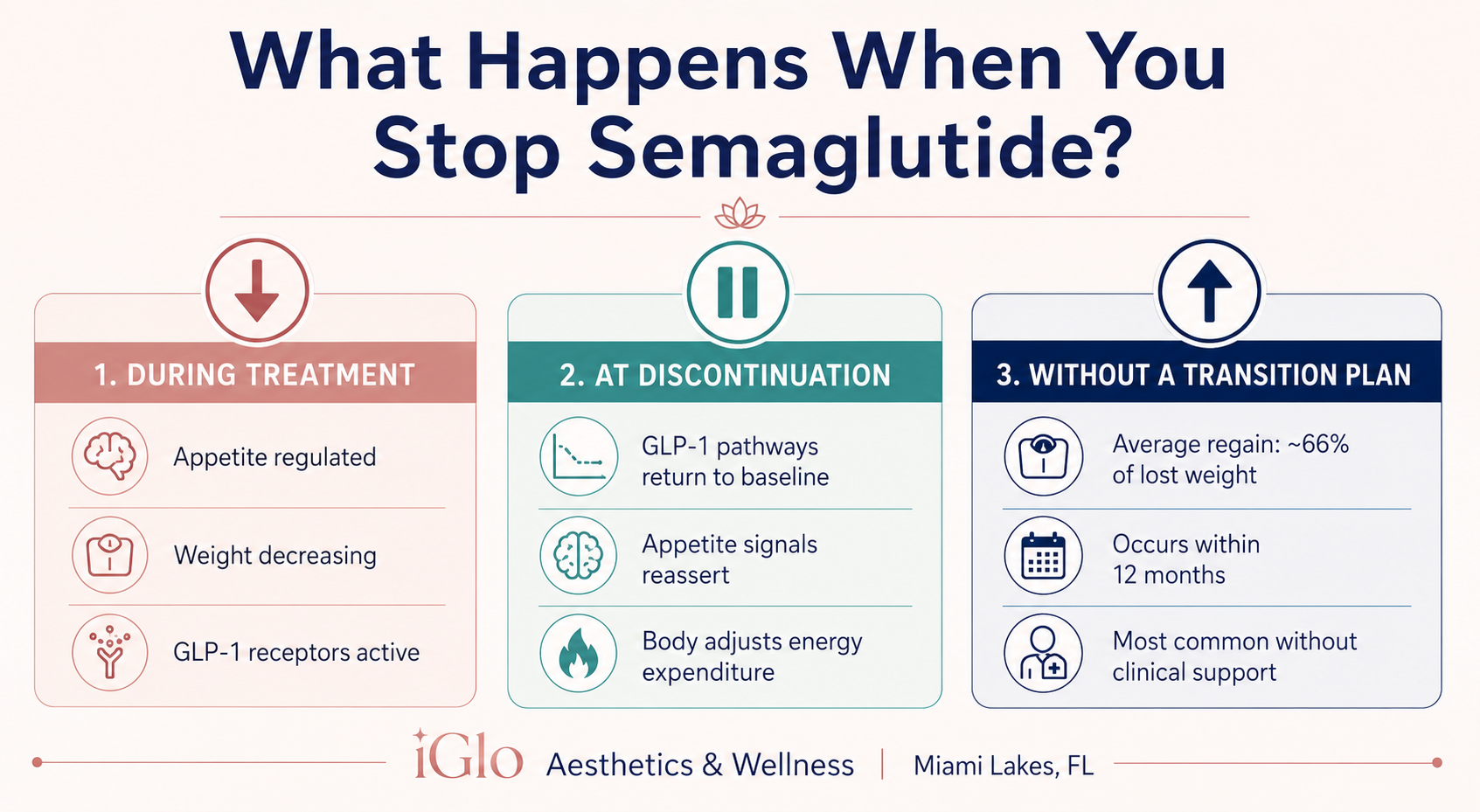
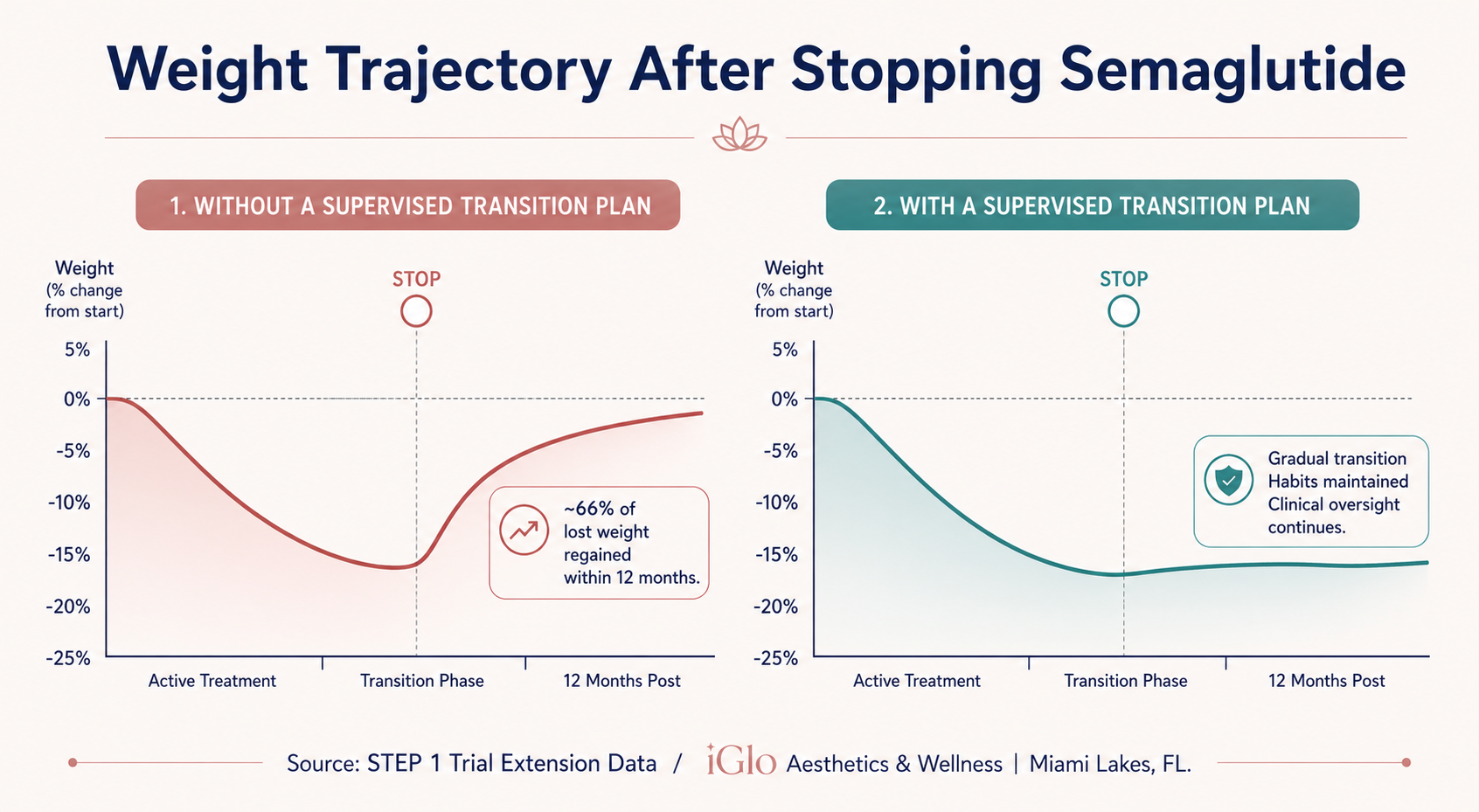
Clinical trial data shows that patients who discontinue semaglutide regain approximately two-thirds of their lost weight within twelve months of stopping. The STEP 1 trial extension, one of the most cited datasets on this question, confirmed this pattern consistently across a broad patient population.
This is not a rare outcome. It's the expected pharmacological response when GLP-1 receptor agonist therapy ends without a structured transition in place. The weight loss achieved during the medication phase does not anchor itself permanently to the body. The medication was doing real biological work, and when that work stops, the body responds.
That's the honest picture. A
complete semaglutide guide for Miami Lakes patients covers the full clinical arc of the medication, including what realistic outcomes look like throughout each phase.
Why Does Weight Come Back After Stopping?
Semaglutide works by binding to GLP-1 receptors that regulate appetite signaling and insulin response. When the medication leaves the system, those pathways return to their pre-treatment state relatively quickly.
For most patients, appetite increases toward baseline levels within weeks. This is not a willpower issue. The body's hunger signals, which semaglutide had been modulating, simply reassert themselves. Metabolic adaptation can also play a role. During significant weight loss, the body adjusts its energy expenditure downward, which means the maintenance calorie target is lower than most patients expect.
The habits built during the medication phase are the primary buffer against rapid regain. Patients who used the appetite suppression window to genuinely restructure eating patterns tend to fare better than those who relied on the medication alone. This is exactly why how a program is structured from the start determines what happens at the end.

What Does a Supervised Program Do Differently to Prepare You?
A supervised program doesn't manage just the medication phase and then step back. It builds toward a planned transition from the first appointment.
At iGlo, that means establishing sustainable eating habits during active treatment, identifying and addressing underlying metabolic contributors, and planning a step-down or transition protocol rather than an abrupt stop. Abrupt discontinuation tends to produce the steepest and fastest regain. A graduated approach, paired with clinical oversight throughout, gives the body and the patient more time to adapt.
The
supervised medical weight loss program at iGlo includes NP oversight from start through the planned transition, so patients are never left managing a significant medical change without support.
Quick Questions
Will I regain weight if I stop semaglutide?
Most patients regain some weight after stopping semaglutide, particularly without a structured maintenance plan. Clinical data shows average regain of approximately two-thirds of lost weight within twelve months of discontinuation. A supervised program that builds sustainable habits during the medication phase and plans the transition proactively significantly reduces regain risk.
Can I restart semaglutide if I regain weight after stopping?
Yes. Most patients are candidates for restarting semaglutide when clinically appropriate. The decision should involve a licensed clinician who can assess your current health status, review what happened during and after the initial program, and determine whether the same or a modified protocol fits your situation.
"Stopping semaglutide is something I plan for from the first appointment, not as an afterthought. The medication is a window, and what you build while that window is open determines what happens after."
— Katrina Friedberg, MSN, APRN, FNP-BC
Ready to Start a Program Built for the Long Term?
Most patients considering semaglutide have already tried approaches that didn't hold. What's different here is the structure behind the medication. Every patient at iGlo Aesthetics & Wellness in Miami Lakes works with Katrina Friedberg, MSN, APRN, FNP-BC, a board-certified nurse practitioner with 10+ years of clinical experience and extensive training in medical aesthetics and wellness.
The program includes a personalized treatment plan, ongoing clinical oversight, and a transition strategy that starts on day one, not as an afterthought at the end.